


Astrophotography
Astrophotography serves as an additional source for gaining an impression of interesting objects both nearby and in deep space. Throughout the year, I will regularly publish a great photo that I have personally selected and taken. Enjoy the photos; there is so much to discover in the night sky.
Using the Seestar S30 Electronic Telescope. The time of capture and exposure time are visible in the photos below.
First example below: Great snapshot from last night, astrophotography https://www.xwingklaus.at/astrophotography/ six galactic nebulae Deep space observation with appropriate exposure and automatic tracking of the Earth's rotation make this possible.
Remark: The New General Catalogue NGC meaning and facts
The acronym NGC stands for "New General Catalogue" of Nebulae and Clusters of Stars. This catalogue is a widely used reference in astronomy for various deep-sky objects, not limited to just nebulae or galaxies, and the letters themselves are an abbreviation for the catalogue's name, not a description of the object's composition
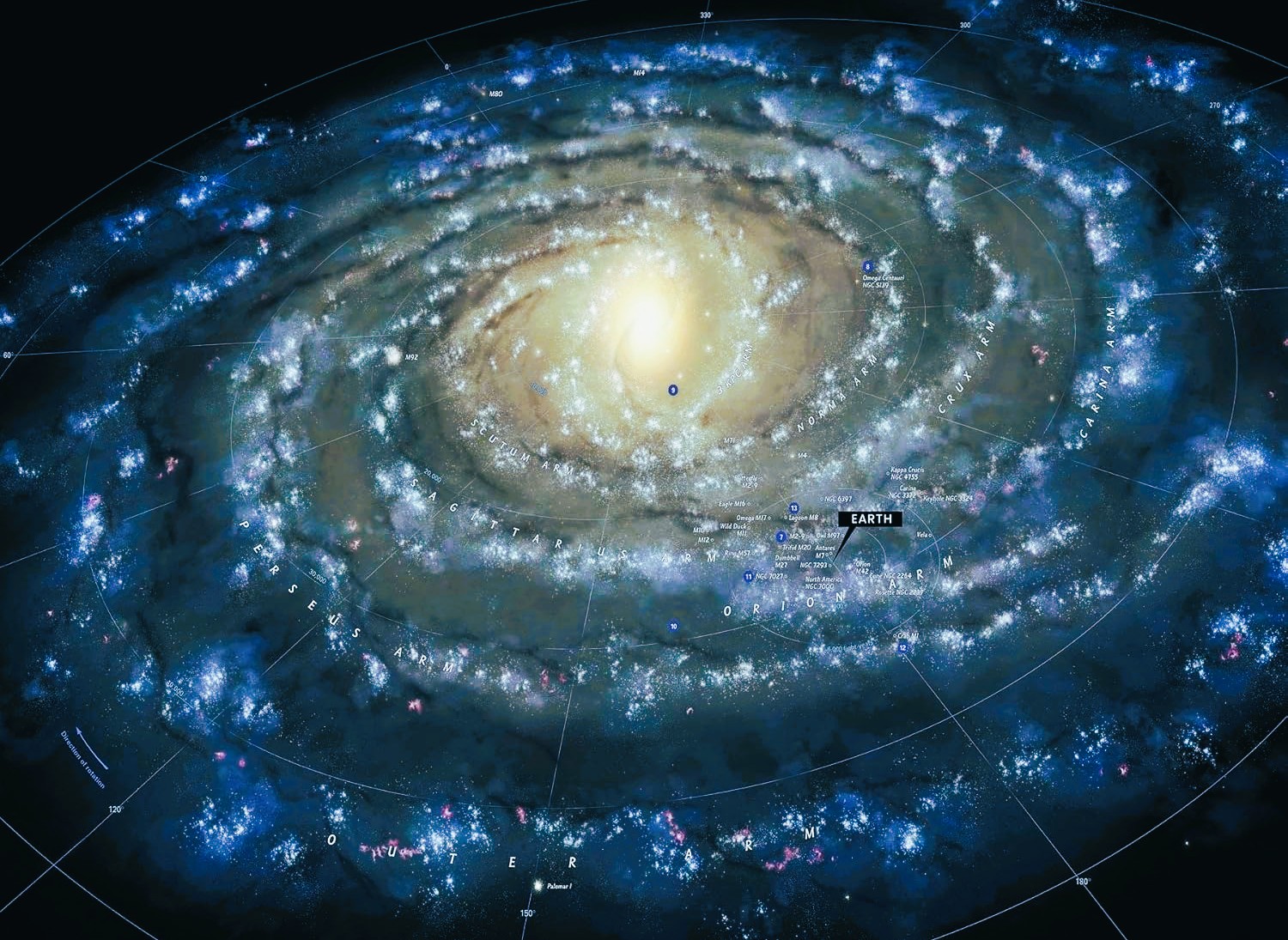
Speed of light ly = 300.000 km/h per second
You see the past!
Examples ly: Moon 1,3 Seconds - Mars 3 Minutes Sun 8 Minutes 20 seconds - Proxima Centauri 4,24 - Pleiades 440 - Horsehead Nebular 1500 - Andromeda Galaxy 2,5 Million - The greatest extent of the observable universe from Earth is approximately 46.5 to 46.6 billion light-years in radius. The diameter of our Milky Way is 105.700.
There is an unimaginably large number of galaxies in the observable universe, with estimates ranging from at least 100 billion to several trillion (2 trillion). Recent research increases the number tenfold compared to earlier estimates and suggests that many small, faint galaxies remain undiscovered. The exact number is unknown because we can only see a portion of the universe. Previous estimates: The Hubble Telescope suggested there were about 100 billion galaxies. Current estimates: Recent analyses of Hubble data indicate at least two trillion galaxies, as many faint, small galaxies were missed. The observable universe: This is the part of the universe whose light has reached us since the Big Bang. Beyond this lie further, unobservable regions that are also thought to contain billions of galaxies. Undiscovered Galaxies: Computer simulations suggest that there could be up to 20 trillion galaxies if one also includes the very small, faint systems.
The universe is approximately 13.8 billion years old, or more precisely, 13.799 ± 0.021 billion years old, having originated from the Big Bang prior to this time. The precise age determination is based on measurements of the cosmic microwave background radiation and the expansion rate of the universe. Age: Current estimates place it at around 13.8 billion years. (source: University Freiburg).
The closest exoplanet to Earth is Proxima Centauri b, which orbits the nearest star to the Sun, Proxima Centauri, and is only about 4.2 light-years away; other planets such as Proxima d have also been discovered in this system, while Gliese 12b is considered the nearest transiting planet with a mild climate, but is farther away.
To date, over 5,000 exoplanets have been discovered, with the exact number varying slightly depending on the source, but consistently above this mark, with current estimates ranging from around 5,300 to over 6,000, with a high discovery rate and new planets being constantly confirmed, often using telescopes such as Kepler and the James Webb Telescope.
Estimates of the number of planets in the universe suggest an unimaginably large number, as planets seem to be the rule rather than the exception around stars. The number of planets is so vast that it far exceeds the estimated number of grains of sand on Earth (approximately 7.5 quintillion). The universe is therefore populated by a quadrillion times the number of worlds.
Illustration of speeds: Journey to the Moon: Light takes about 1 second to travel. The Apollo astronauts needed approximately 3 days. Journey to the nearest star (Proxima Centauri): At the speed of light, it would take 4.2 years. With current Voyager technology, the journey would take over 70,000 years.
The TRAPPIST-1 system features seven Earth-sized, rocky exoplanets orbiting an ultra-cool red dwarf star about 40 light-years away, making it a prime target for studying potentially habitable worlds, with several planets residing in the star's habitable zone, though their close proximity means they're likely tidally locked, presenting challenges for atmosphere retention but exciting possibilities for water and potential life, observed extensively by JWST
Photo: (c) IPAC/Caltech, Standard, National Geographic, Nasa

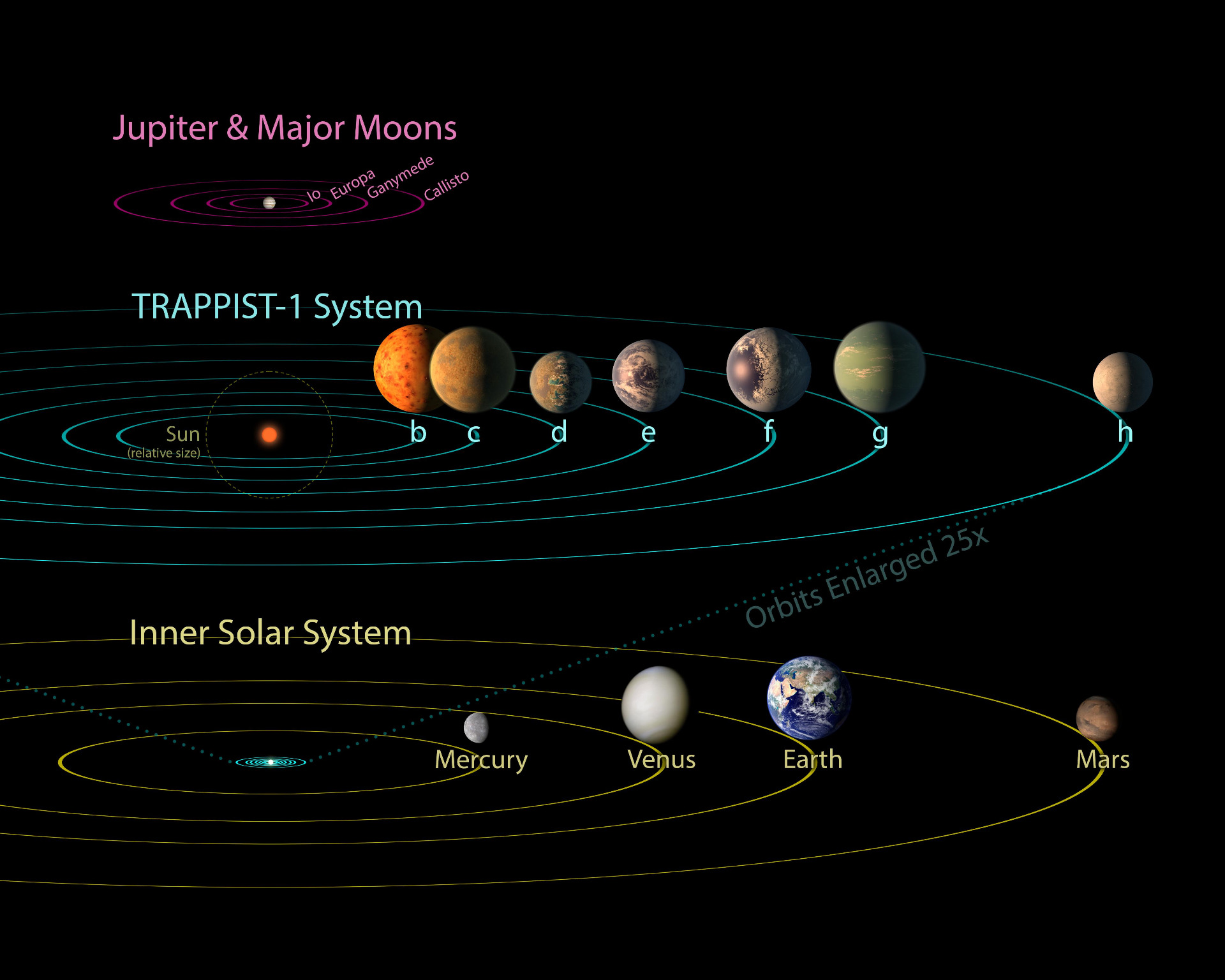
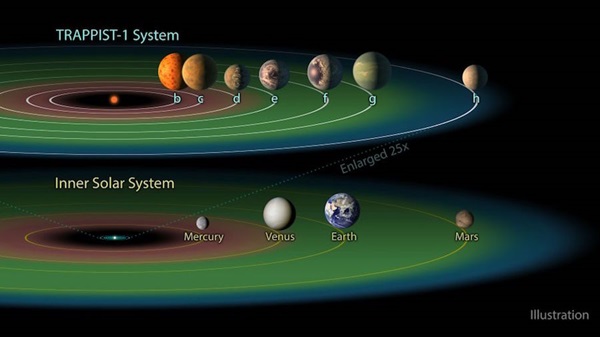
The TRAPPIST-1 system
The TRAPPIST-1 system features seven Earth-sized, rocky exoplanets orbiting an ultra-cool red dwarf star about 40 light-years away, making it a prime target for studying potentially habitable worlds, with several planets residing in the star's habitable zone, though their close proximity means they're likely tidally locked, presenting challenges for atmosphere retention but exciting possibilities for water and potential life, observed extensively by JWST. Key Facts:
Star Type: An ultra-cool, tiny red dwarf (M-dwarf), much smaller and cooler than our Sun, making planets appear brighter during transits.
Distance: Located approximately 40 light-years from Earth in the constellation Aquarius.
Planets: Seven terrestrial (rocky) planets, labeled B through H, roughly Earth-sized, orbiting very closely.
Habitable Zone: Multiple planets (e, f, g) orbit within the star's habitable zone, where liquid water could exist.
Tidal Locking: Most, if not all, planets are likely tidally locked, permanently facing their star, creating extreme temperature differences.
Discovery: First identified by the TRAPPIST telescope, with the full seven-planet system confirmed by Spitzer.

Fotogalerie
Sunlight takes approximately
8 minutes and 20 seconds (about 499 seconds) to reach Earth, as the average distance is about 150 million kilometers and light travels at nearly 300,000 km/s. This means we always see the sun as it appeared about eight minutes ago.
Light travel time: 8 minutes 19 seconds / 8.3 minutes
Distance (average): approx. 150 million km (more precisely 149.6 million km)
Speed of light: 299,792.458 km/s
Light takes about 1.3 seconds (or 1.28 seconds) to travel from the Moon to Earth, since the average distance is approximately 384,400 kilometers and light travels at about 300,000 km/s; conversely, a radio signal also takes about 1.3 seconds to travel the same distance. Distance: The Earth-Moon distance is not constant, but averages about 384,400 km. Travel time: Due to this distance, light (or a radio signal) takes slightly more than one second to cover the distance. Example: During the Apollo 11 moon landing, it took 1.3 seconds for Neil Armstrong's famous words to reach Earth, a direct consequence of this travel time.

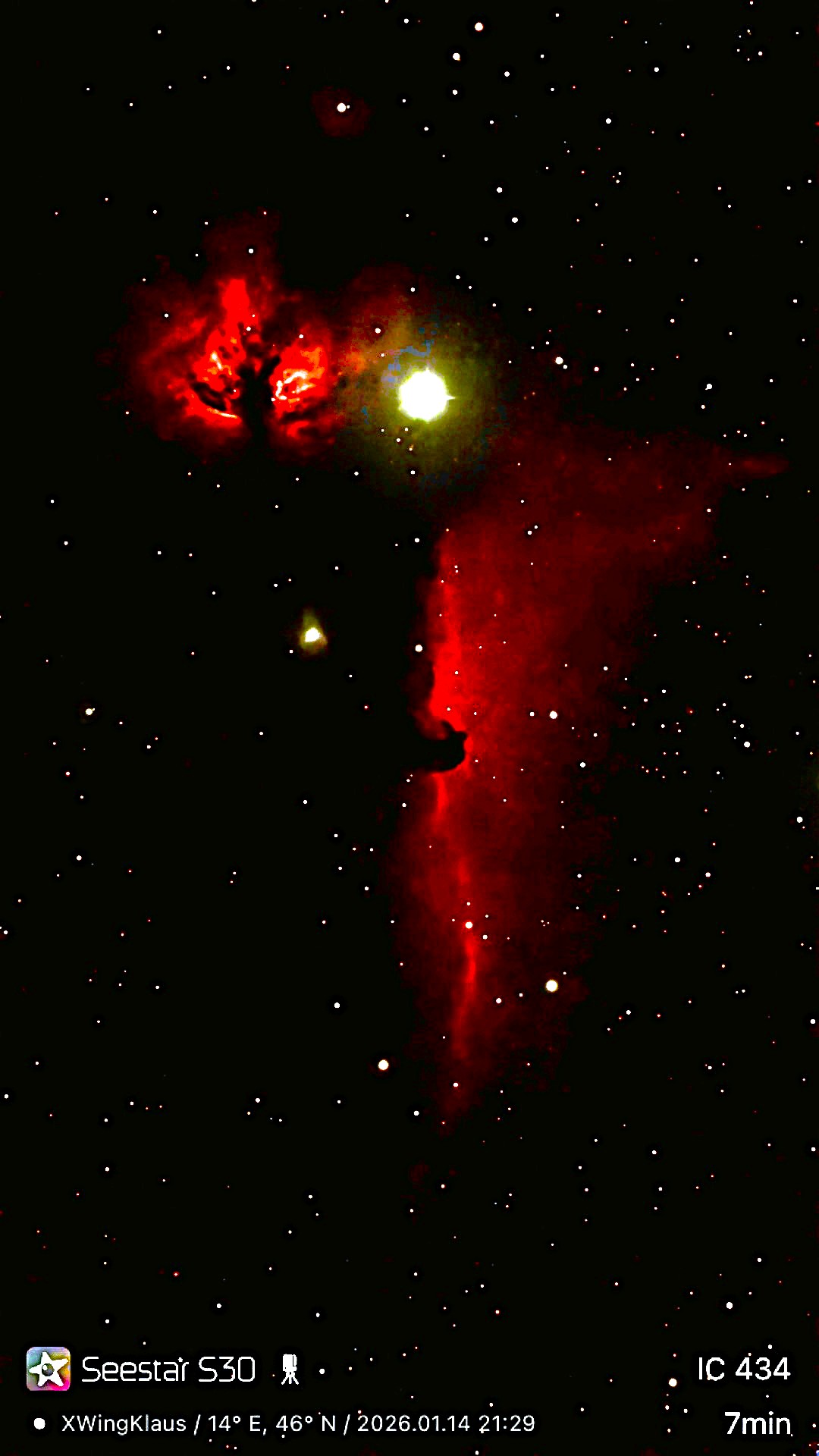
IC 434 Horsehead Nebula
IC 434 is a bright emission nebula in the equatorial constellation of Orion. It was discovered on February 1, 1786, by German-British astronomer William Herschel.[2] The nebula is located at a distance of approximately 1,500 ly (385 pc) from the Sun.

The Horsehead Nebula is part of a dark cloud in the constellation Orion, which stands out against the red-glowing emission nebula IC 434 with a silhouette resembling a horse's head. The nebula is approximately 1,500 light-years from Earth and appears about a quarter the size of the Moon.The Milky Way has a diameter of approximately 100,000 light-years. Our solar system is 26,000 light-years from the center of the galaxy. All objects in the galaxy orbit its center. 09.01.2025
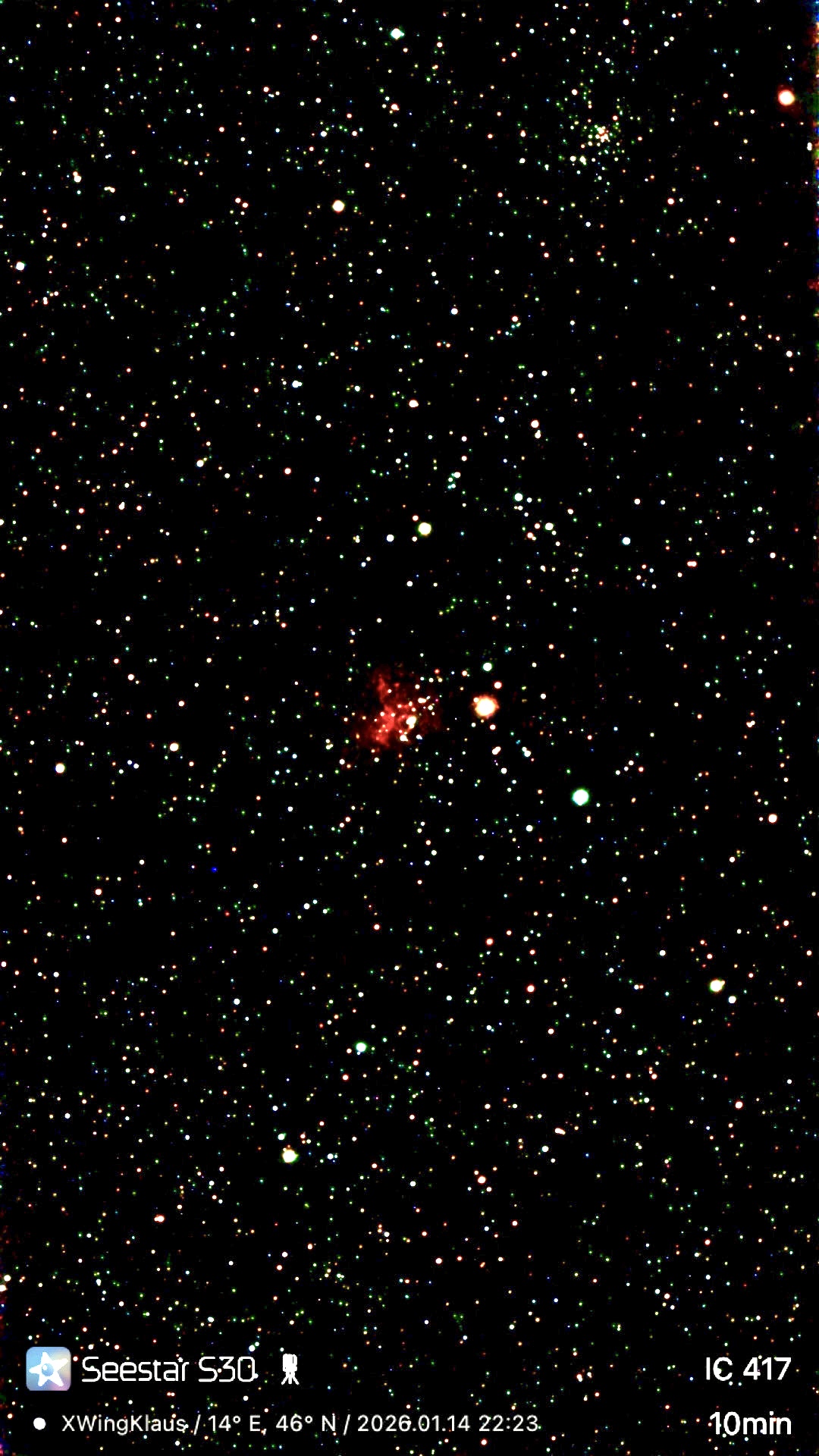
IC 517 Spider Nebula
IC 417, the Spider Nebula, is a star-forming emission nebula in the Auriga constellation, about 10,000 light-years away, known for its glowing hydrogen gas energized by massive young blue stars, creating pinkish-red hues and structures resembling a spider, often photographed alongside its neighbor, the Fly Nebula (NGC 1931).

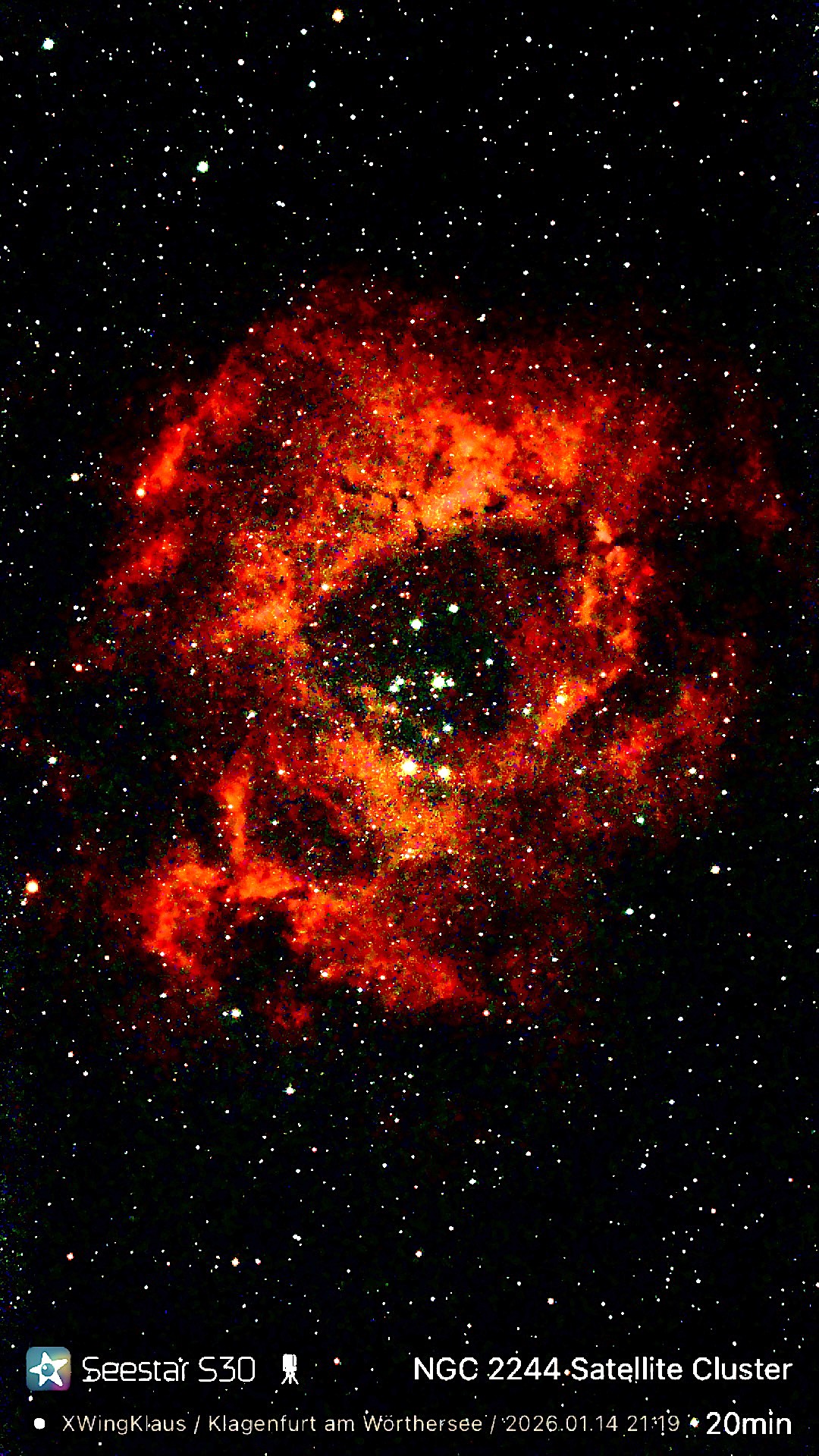
NGC 2244 Cluster
NGC 2244 is a young, open star cluster at the heart of the Rosette Nebula in the constellation Monoceros, known for its hot, massive O-type stars that illuminate the surrounding gas and carve out a central cavity with their stellar winds. Discovered by John Flamsteed around 1690, this star-forming region is about 5,000 light-years away and spans over 100 light-years, with the cluster's intense UV radiation causing the nebula's glow.
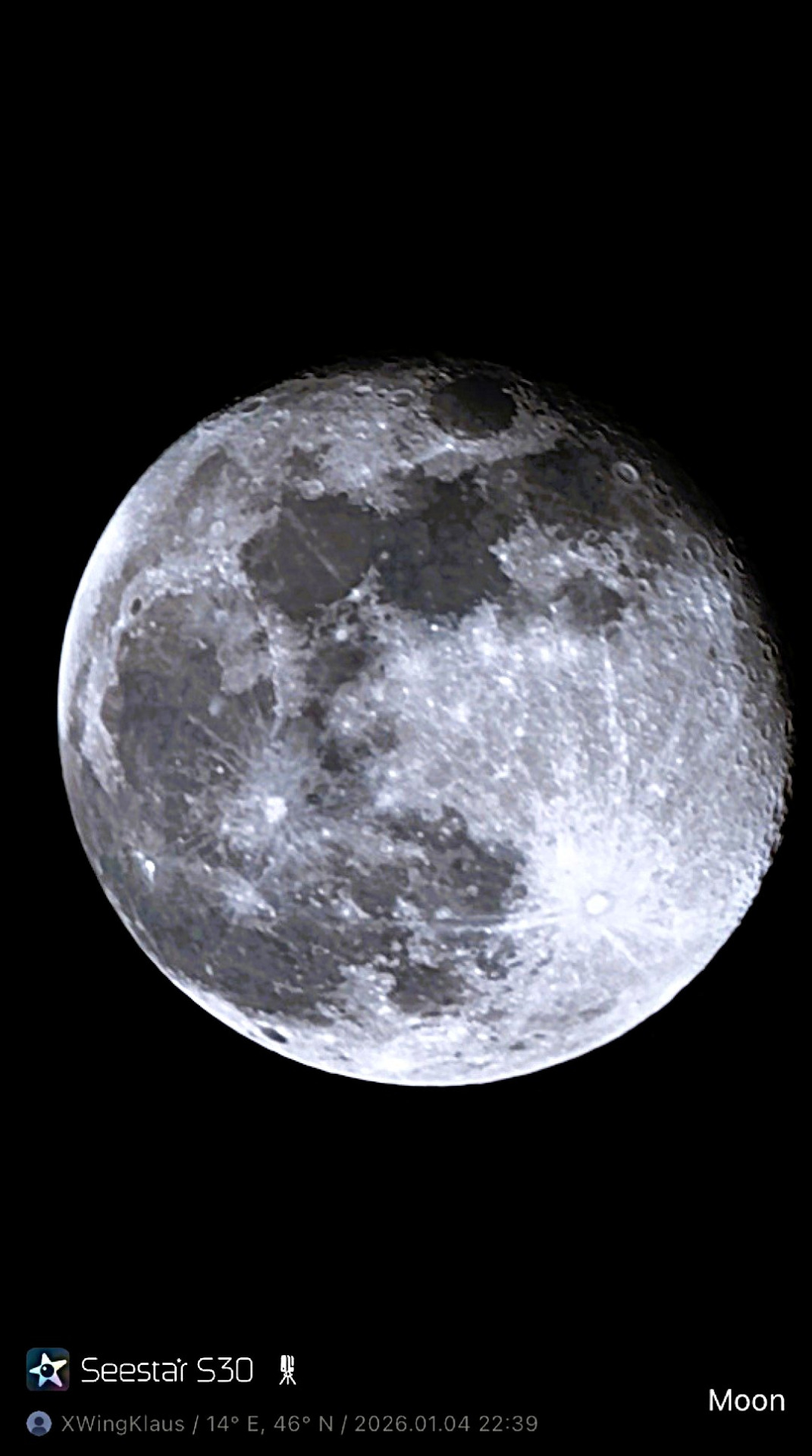
Moon
The Moon is Earth's natural satellite, a cratered, geologically significant body holding clues to the solar system's history, while Artemis II is NASA's first crewed lunar flyby mission (planned for 2026) using the SLS rocket and Orion spacecraft, testing systems for future landings, sending four astronauts around the Moon but not landing, to pave the way for sustainable lunar presence and Mars exploration. Key facts include the Moon's ancient, preserved history and Artemis II's role as a critical, deep-space human flight test
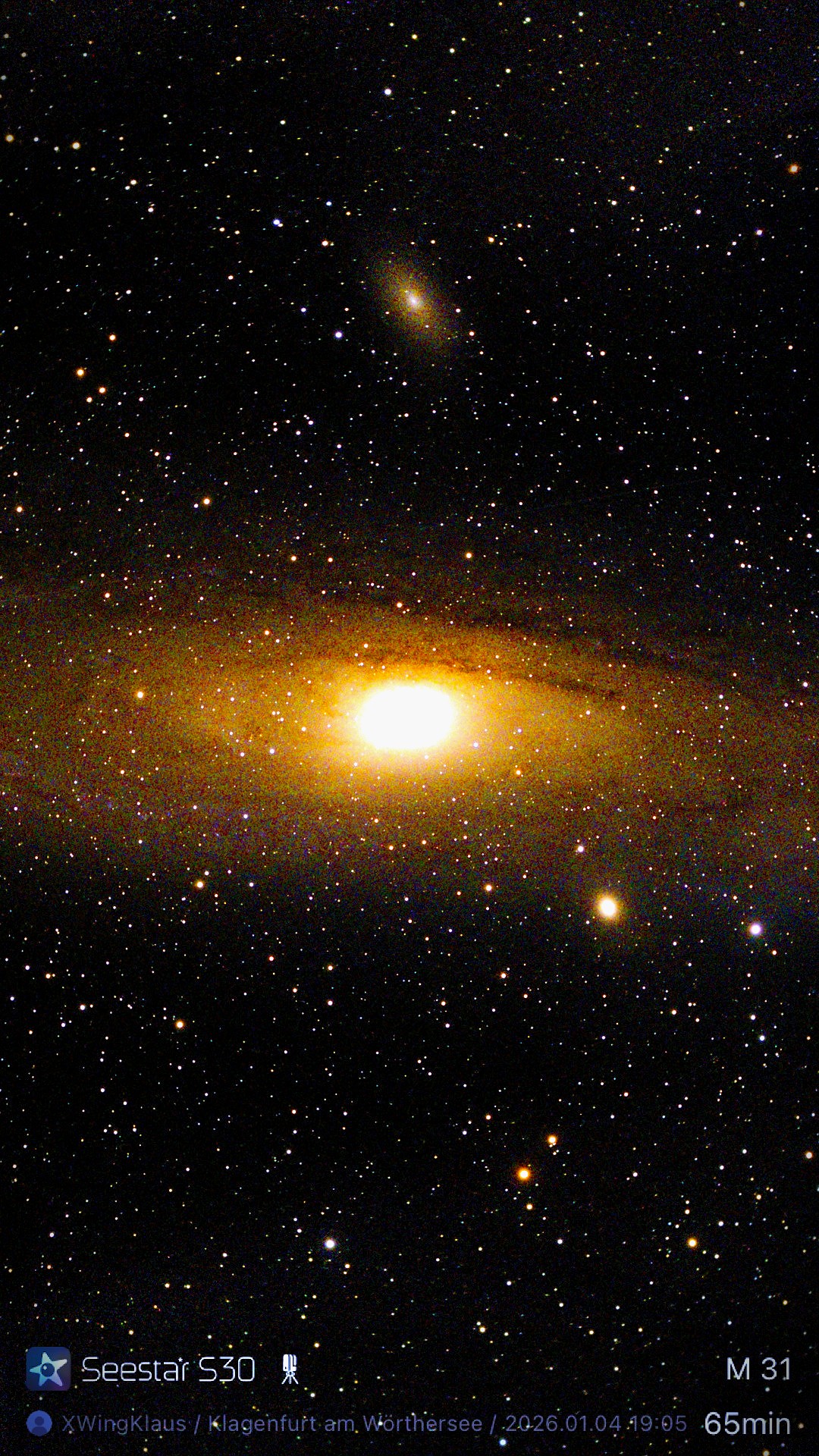
M31 Andromeda Galaxy
M31, the Andromeda Galaxy, is our closest large galactic neighbor, a massive spiral galaxy about 2.5 million light-years away, visible to the naked eye as a faint smudge in the constellation Andromeda. It's larger than the Milky Way, contains roughly a trillion stars, has a crowded double nucleus with a supermassive black hole, and is heading towards a spectacular collision and merger with our galaxy in about 4.5 billion years, forming a new giant elliptical galaxy.

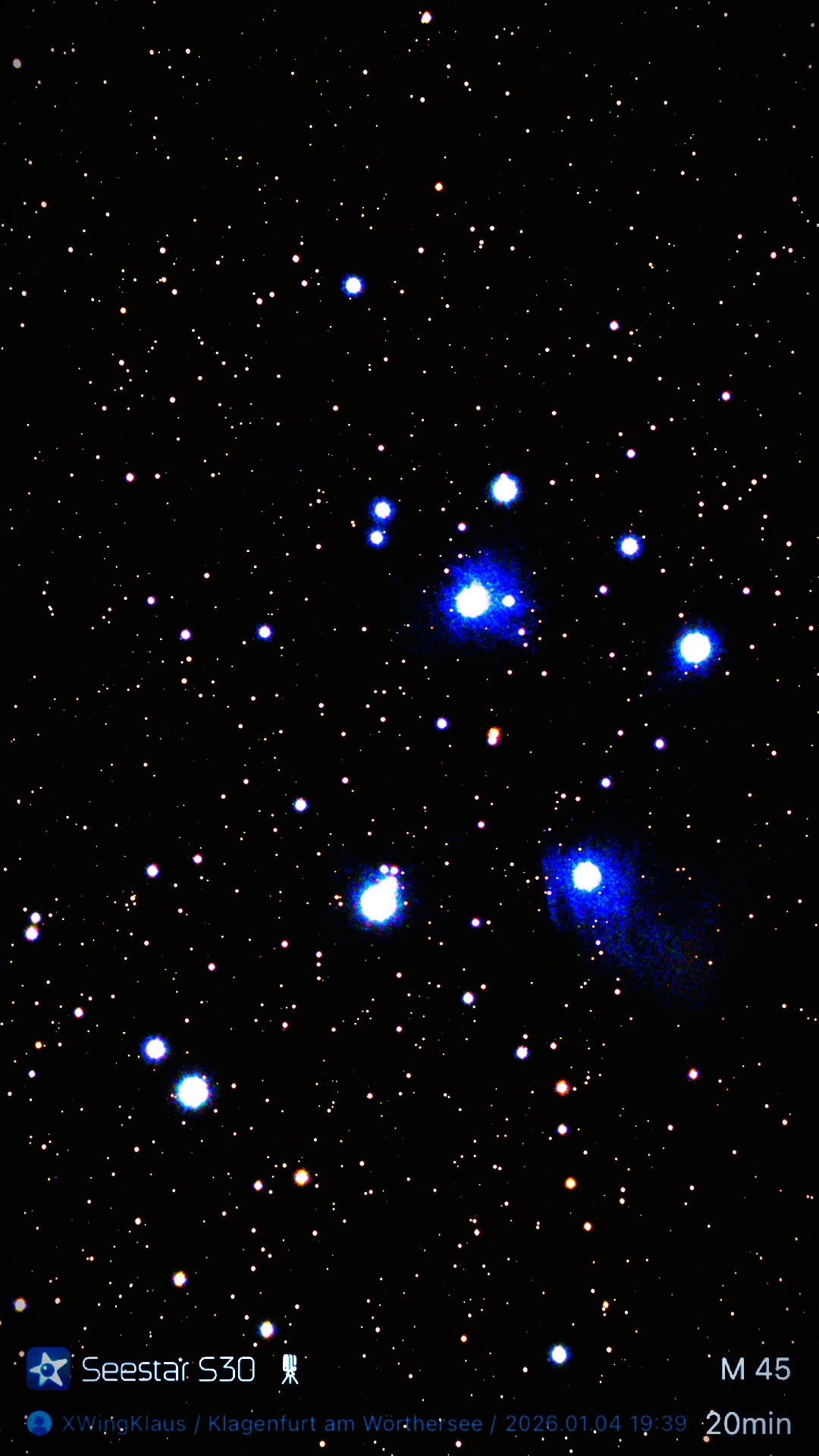
M45 Pleiades
The Pleiades, also known as the Seven Sisters or Messier 45 (M45), is a nearby and prominent open star cluster in the constellation Taurus. It has been a significant object in human culture and astronomy for millennia.
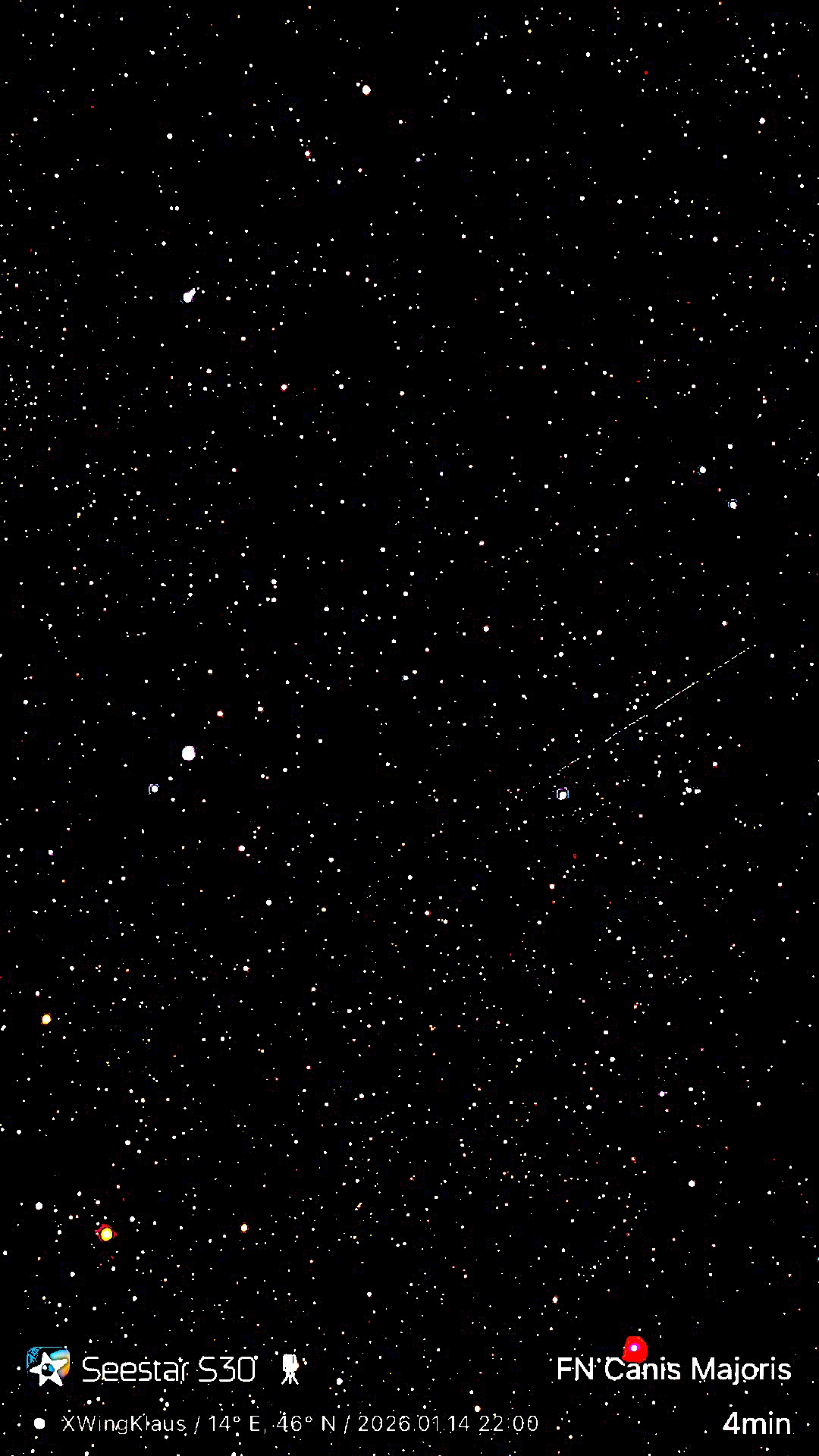
FN Canis Majoris
FN Canis Majoris is a luminous, hot binary star system about 3,000 light-years away, famous for its dramatic bow shock created as it races through the interstellar medium, likely ejected from its birth cluster, forming part of the massive CMa OB1 association and interacting with the Sh 2-296 nebula (part of the Seagull Nebula complex). This runaway star system features a massive primary star (around 19-36 solar masses) that's extremely luminous, producing bright blue-white light and being a significant source of ultraviolet radiation.
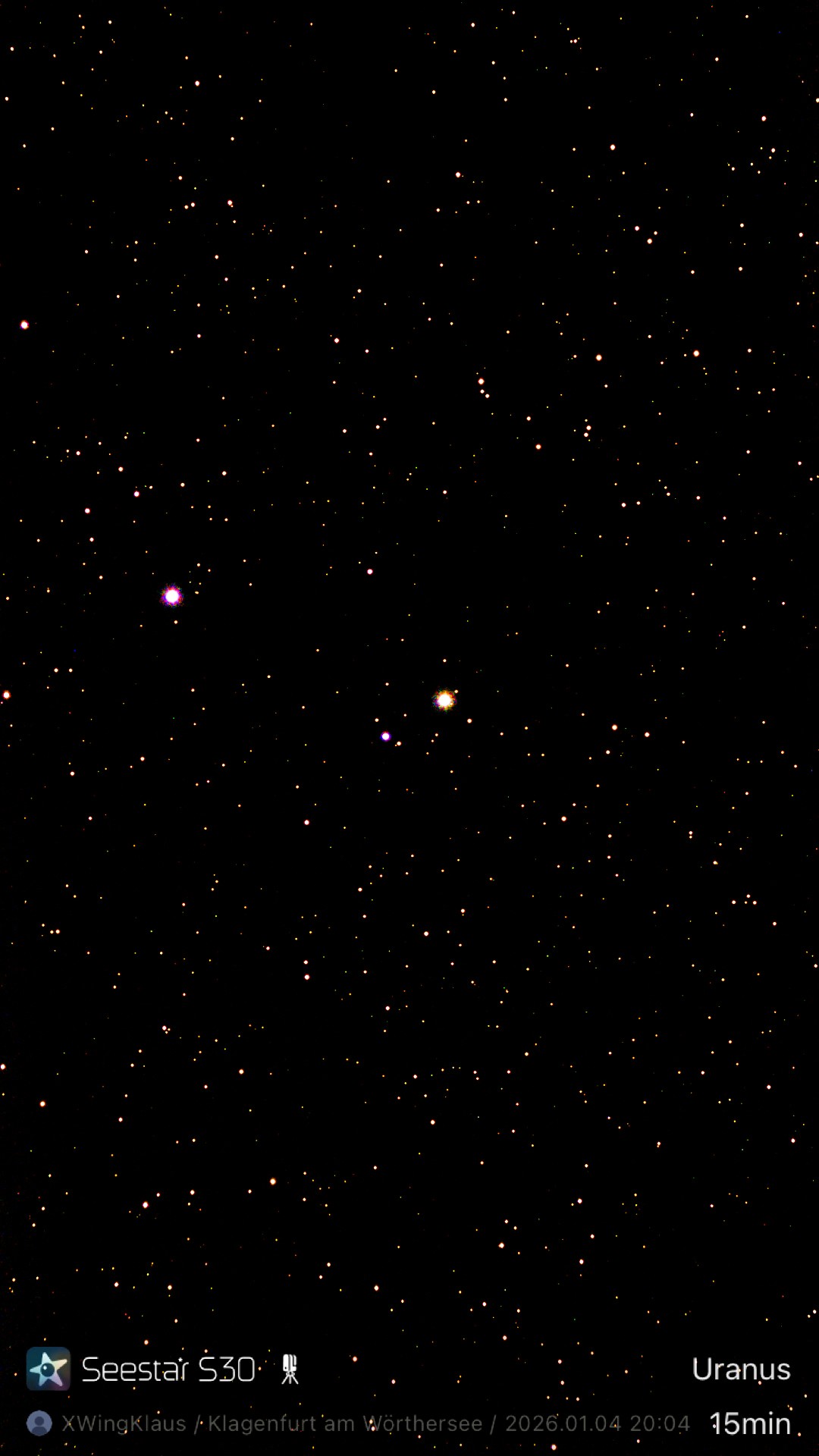
Planet Uranus
Uranus is the seventh planet, known as an ice giant with a blue-green hue from methane, famous for spinning on its side with an extreme axial tilt, giving it decades-long seasons, and possessing faint rings and 27 moons named after literary characters. Discovered by telescope, it's the coldest planet, despite not being the farthest, and it experiences extreme weather with hydrogen sulfide clouds that might smell like rotten eggs.